































Funeral flowers in Vietnam are more than a message of condolence: they are a way to show respect for the person who has died and to share the family’s grief. Every wreath carries a ribbon with a short printed line, and getting that line right matters, because it tells the family who you are and how you stand in relation to the deceased. In this guide Flosa explains what to write on a funeral wreath so that it is formal, complete and suited to your relationship with the family. The wording on the ribbon is always in Vietnamese, so each phrase below is given exactly as it is printed, followed by its meaning in English.
What a funeral wreath means at a Vietnamese funeral
In Vietnamese culture, as in many others, a sympathy wreath carries several layers of meaning:
Respect and gratitude: fresh flowers arranged in a wreath stand for respect, thankfulness and lasting remembrance of what the person gave and the memories they leave behind.
Comfort and sympathy: the wreath is the sender’s sincere word of support to the bereaved family at the most painful moment.
Shared grief: through the wreath, the mourner says that they feel the loss too.
A sincere farewell: it is also a last goodbye, a respectful final message to the deceased.
A wish for peaceful rest: the flowers carry a wish that the departed may go gently and soon reach a place of lasting peace, in Buddhist terms, the Pure Land.
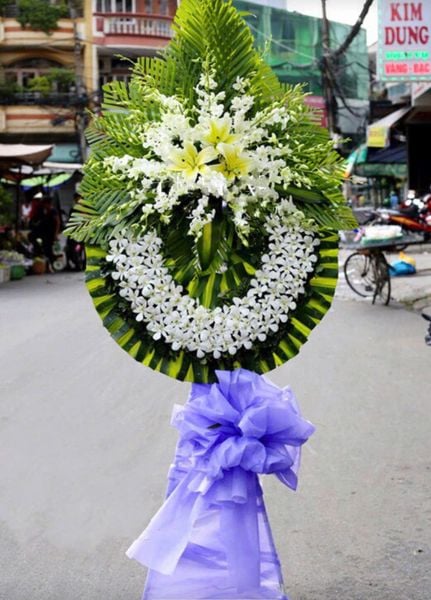
Funeral wreath “Fond Remembrance” (HTL38), a sign of respect and shared grief
What to write on a funeral wreath: the formal wording
The text on the ribbon should be dignified, short and to the point, while still carrying the sender’s feeling.
General principles:
The wording should show respect and sympathy.
Use formal, respectful words. Avoid anything negative, overly mournful or out of keeping with the atmosphere of a funeral.
The sender’s name, whether one person or a group, should be written clearly and formally.
Kính viếng (“Respectfully paying our respects”), the most common and most formal line:
This is the phrase used at most funerals in Vietnam and is regarded as the most formal.
Meaning: kính means respect or reverence; viếng means to come and pay a condolence visit. Together, Kính viếng expresses the mourner’s deep respect for the person who has died.
Who uses it: people who are younger than, junior to or on the same level as the deceased, and groups such as a company, an office or an association. It suits almost any situation: a relative, grandparents, parents, a friend, a business partner. It is the usual choice in the north, the centre and the south of the country alike.
Typical lines: Kính viếng Cụ/Bác/Ông/Bà/Anh/Chị… (“Respectfully paying our respects to…”, followed by the form of address that fits the deceased: a very elderly person, an uncle or aunt, a grandfather or older man, a grandmother or older woman, an older brother, an older sister), or Kính viếng hương hồn Anh/Chị/Em… (“Respectfully paying our respects to the spirit of…”).
The version with hương hồn (“the spirit of the departed”) goes a little deeper: it addresses the soul of the deceased directly and is considered especially reverent.
Vô cùng thương tiếc (“With boundless sorrow” / “Deeply mourned”), profound grief and regret:
This phrase speaks plainly of deep sadness, pain and regret at someone’s death.
Who uses it: usually a sender who is senior to the deceased, grandparents mourning a grandchild, parents mourning a child, an older sibling mourning a younger one, a superior mourning a member of staff. As the family samples below show, the closest relatives also use it for their own dead.
It conveys heartfelt pain and loss.
Typical line: Vô cùng thương tiếc Em/Cháu/Con… (“Deeply mourning our younger brother or sister / grandchild, niece or nephew / child…”), followed by the name of the deceased.
Thành kính phân ưu / Thành kính chia buồn (“With deepest sympathy”), sincere fellow-feeling:
Meaning: both phrases mean sharing the family’s pain, with reverence and sympathy. Thành is sincerity, kính is respect, and phân ưu is to share someone’s sorrow. Chia buồn is the everyday Vietnamese for the same idea.
Who uses it: mourners who want to offer comfort and support to the family. It fits social relationships very well: colleagues, friends, business partners.
Typical lines: Thành kính phân ưu cùng gia đình… (“With deepest sympathy to the family of…”, followed by the name of the deceased or the head of the household); Thành kính phân ưu trước sự mất mát to lớn của gia đình… (“With deepest sympathy for the great loss suffered by the family of…”); Thành kính chia buồn cùng gia đình… (“Sincere condolences to the family of…”); Thành kính chia buồn trước sự ra đi của… (“Sincere condolences on the passing of…”).
Xin chia buồn (“Our condolences”), short and sincere:
A brief, simple line that still says everything: sympathy, and a wish to share the family’s sadness.
Who uses it: the same people as Thành kính phân ưu, social acquaintances, colleagues, friends.
Typical lines: Xin chia buồn cùng gia đình… (“Our condolences to the family of…”); Xin chia buồn trước nỗi mất mát to lớn của gia đình… (“Our condolences on the great loss suffered by the family of…”).
Kính điếu (“Respectfully mourning”), a southern usage:
This line is seen more often in the southern provinces.
In the north it is less common and may not be understood as readily as Kính viếng.
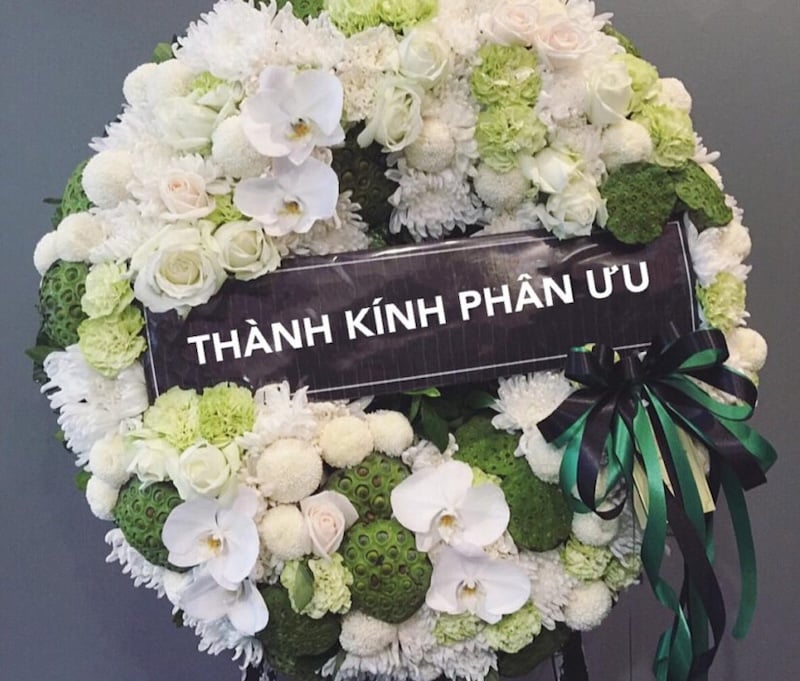
Thành kính phân ưu is used at funerals to express condolence, reverence and sympathy with the family of the deceased.
See also: What to wear to a funeral in Vietnam
Wording for each sender: getting the relationship right
What goes on the ribbon changes with who is sending the wreath and how they are related to the deceased and the family. The line should show the right degree of feeling and respect, and reflect the sender’s place in the family or social order. Vietnamese forms of address depend on age and seniority, and the ribbon follows the same logic. The samples below are printed in capitals, as they appear on a ribbon; where several forms of address are separated by a slash, choose the one that applies.
From the family, on the father’s or the mother’s side
These are the closest relatives, and the wording usually shows the grief of blood ties.
VỢ / CHỒNG CÙNG CÁC CON CHÁU VÔ CÙNG THƯƠNG TIẾC ÔNG/BÀ/CHA/MẸ, “Wife / husband, with children and grandchildren, deeply mourning our grandfather / grandmother / father / mother.” A variant names the spouse: Chồng/Vợ … cùng các con, cháu, chắt vô cùng thương tiếc (“Husband / wife [name], with children, grandchildren and great-grandchildren, in deepest sorrow”).
GIA ĐÌNH BÊN NỘI VÔ CÙNG THƯƠNG TIẾC ÔNG/BÀ/BÁC/CHÚ/CÔ…, “The paternal side of the family, deeply mourning our grandfather / grandmother / uncle / aunt…”
GIA ĐÌNH BÊN NGOẠI VÔ CÙNG THƯƠNG TIẾC ÔNG/BÀ/CẬU/MỢ/DÌ…, “The maternal side of the family, deeply mourning our grandfather / grandmother / uncle / aunt…”
GIA ĐÌNH ANH/CHỊ/EM … CÙNG CÁC CHÁU VÔ CÙNG THƯƠNG TIẾC, “The family of brother / sister [name of the person representing the household], with the children, in deepest sorrow.” For example: GIA ĐÌNH ANH NAM CHỊ LAN CÙNG CÁC CHÁU VÔ CÙNG THƯƠNG TIẾC EM A (“The family of Nam and Lan, with the children, deeply mourning our younger brother or sister A”).
CÁC CON, CHÁU, CHẮT BÊN NỘI VÔ CÙNG THƯƠNG TIẾC ÔNG/BÀ, “The children, grandchildren and great-grandchildren on the paternal side, deeply mourning our grandfather / grandmother.” For the maternal side, replace BÊN NỘI with BÊN NGOẠI.
CÁC ANH, CHỊ, EM, CÔ, DÌ, CHÚ, BÁC BÊN NỘI VÔ CÙNG THƯƠNG TIẾC, “The brothers, sisters, aunts and uncles on the paternal side, in deepest sorrow” (or BÊN NGOẠI for the maternal side).
From the in-laws
In Vietnam the two families joined by a marriage are called thông gia (in the south, sui gia), and each is expected to send a wreath when the other is bereaved. The wording should be formal and show the bond between the two households.
When a parent of your in-laws dies (that is, a grandparent of your son- or daughter-in-law):
GIA ĐÌNH ÔNG BÀ A - B THÔNG GIA VỚI ÔNG BÀ C - D KÍNH VIẾNG CỤ, “The family of Mr and Mrs A–B, in-laws of Mr and Mrs C–D, respectfully paying our respects to the elder.” A–B are the couple sending the wreath; C–D are the parents of their son- or daughter-in-law, one of whom is the child of the deceased. For example: GIA ĐÌNH ÔNG BÀ NAM - HUYỀN THÔNG GIA VỚI ÔNG BÀ HÙNG - NHI KÍNH VIẾNG CỤ X.
When your direct in-law dies (the father or mother of your son- or daughter-in-law):
GIA ĐÌNH ÔNG BÀ A - B THÔNG GIA KÍNH VIẾNG ÔNG/BÀ Y, “The in-law family of Mr and Mrs A–B, respectfully paying our respects to Mr / Mrs Y.” For example: GIA ĐÌNH ÔNG BÀ NAM - HUYỀN THÔNG GIA KÍNH VIẾNG.
When the children of the in-law family attend (because the in-law couple themselves have died or cannot come):
GIA ĐÌNH CON CHÁU ÔNG BÀ THÔNG GIA … TẠI … KÍNH VIẾNG, “The children and grandchildren of the in-laws Mr and Mrs [names of the couple who have died or are absent], of [the senders’ home town], respectfully paying our respects.” For example: GIA ĐÌNH CON CHÁU ÔNG BÀ NAM, HUYỀN THÔNG GIA TẠI HÀ NỘI KÍNH VIẾNG (“…of Hanoi”).
Other in-law wordings in use:
GIA ĐÌNH ÔNG BÀ THÔNG GIA ABC KÍNH VIẾNG, “The in-law family of Mr and Mrs ABC, respectfully paying our respects.” If the in-law couple have already died, the names can be left out and the line kept general.
GIA ĐÌNH SUI GIA TẠI VŨNG TÀU KÍNH VIẾNG, “The in-law family in Vung Tau, respectfully paying our respects” (use your own town or province; VÔ CÙNG THƯƠNG TIẾC can replace KÍNH VIẾNG).
GIA ĐÌNH THÔNG GIA (CON RỂ ABC / CON DÂU XYZ) KÍNH VIẾNG, “The in-law family (son-in-law ABC / daughter-in-law XYZ), respectfully paying our respects.” Name the son- or daughter-in-law; you can also add their place in the family, such as youngest daughter or eldest son.
GIA ĐÌNH ÔNG BÀ THÔNG GIA TIẾN - HẰNG CÙNG CÁC CON CHÁU VÔ CÙNG THƯƠNG TIẾC, “The in-law family of Mr and Mrs Tien–Hang, with children and grandchildren, in deepest sorrow.” The parents’ names are written when they are alive and attending.
GIA ĐÌNH THÔNG GIA CÙNG CÁC CON CHÁU TẠI HÀ NỘI VÔ CÙNG THƯƠNG TIẾC, “The in-law family, with children and grandchildren, in Hanoi, in deepest sorrow.” Used when the family prefers not to give the parents’ names.
Whether the ribbon says gia đình thông gia kính viếng or gia đình sui gia kính viếng, both mean “the in-law family pays its respects” and both show how much the tie between the two households is valued.
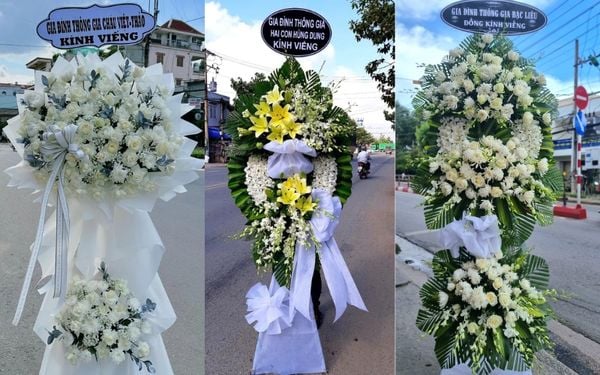
Formal ribbon wording for a wreath sent by the in-law family
From a company or organisation
The wording should be formal, courteous and collegial.
For a member of staff, or a member of staff’s relative:
TẬP THỂ PHÒNG / BAN … CÔNG TY ABC KÍNH VIẾNG, “All staff of the … department, ABC Company, respectfully paying our respects.”
CÔNG ĐOÀN CÔNG TY ABC KÍNH VIẾNG, “The trade union of ABC Company, respectfully paying our respects.”
CÔNG TY ABC KÍNH VIẾNG, “ABC Company, respectfully paying our respects.”
BAN GIÁM ĐỐC CÙNG TẬP THỂ NHÂN VIÊN CÔNG TY … KÍNH VIẾNG: “The board of directors and all staff of … Company, respectfully paying our respects.”
BAN LÃNH ĐẠO CÙNG TẬP THỂ CÔNG TY XYZ KÍNH VIẾNG HƯƠNG HỒN CÔ/BÁC/ANH/CHỊ …, “The management and all staff of XYZ Company, respectfully paying our respects to the spirit of [form of address and name of the deceased].”
BAN GIÁM ĐỐC VÀ TOÀN THỂ NHÂN VIÊN CÔNG TY ABC THÀNH KÍNH PHÂN ƯU, “The board of directors and all staff of ABC Company, with deepest sympathy.”
For a partner company, or a relative of someone at a partner company:
CÔNG TY ABC KÍNH VIẾNG, “ABC Company, respectfully paying our respects.” Give your own company’s name in full.
CÔNG TY XYZ KÍNH VIẾNG HƯƠNG HỒN CÔ/BÁC/ANH/CHỊ …, “XYZ Company, respectfully paying our respects to the spirit of [form of address and name of the deceased].”
In the south, the same line may end in KÍNH ĐIẾU instead: CÔNG TY ABC KÍNH ĐIẾU (“ABC Company, respectfully mourning”).
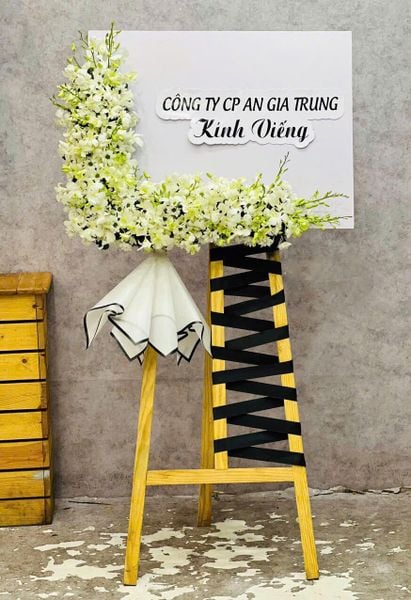
Ribbon wording from an organisation: funeral flowers “Words of Gratitude” (HTL122)
From a class, a school, people of the same age or army intake, and friends
TẬP THỂ LỚP A12 - KHÓA … TRƯỜNG XYZ KÍNH VIẾNG, “Class A12, year of …, XYZ School, respectfully paying our respects” (the year is the year of graduation). Real ribbons read, for instance, Tập thể học sinh lớp 11A5 Trường THPT Vũng Tàu kính viếng or Tập thể lớp 12A Trường THPT Lê Quý Đôn kính viếng, the pupils of a named class at a named secondary school.
BAN GIÁM HIỆU NHÀ TRƯỜNG ABC KÍNH VIẾNG, “The board of governors of ABC School, respectfully paying our respects.”
HỘI CHA MẸ HỌC SINH TRƯỜNG ABC KÍNH VIẾNG, “The parents’ association of ABC School, respectfully paying our respects.”
HỘI ĐỒNG NIÊN 1989 KÍNH VIẾNG, “The association of those born in 1989, respectfully paying our respects.” People born in the same year often form such a group in their home village.
HỘI ĐỒNG NGŨ NHẬP NGŨ NĂM 1989 KÍNH VIẾNG, “The comrades who enlisted in 1989, respectfully paying our respects.”
Friends mourning a friend’s relative (for example, a friend’s father or mother):
For a friend’s father or mother, from one person or a small group: CÁC CHÁU HÙNG - TÂM - KHA BẠN CỦA AN KÍNH VIẾNG, “Hung, Tam and Kha, friends of An, respectfully paying our respects.” The senders call themselves các cháu (roughly “your nephews and nieces”), the polite way for younger people to refer to themselves before a friend’s parent. In short: Các cháu A, B bạn của C kính viếng.
When the friend is the one who has died, from a group of friends: NHÓM BẠN THÂN Ở VŨNG TÀU KÍNH VIẾNG BẠN A. “Your close friends in Vung Tau, respectfully paying our respects to our friend A.” Also: Nhóm bạn thân của A thành kính phân ưu (“A’s close friends, with deepest sympathy”).
When a whole class or company mourns a friend’s relative: TẬP THỂ HỌC SINH LỚP 11A5 TRƯỜNG THPT VŨNG TÀU KÍNH VIẾNG, followed by the relationship, ÔNG/BÀ/CHA/MẸ CỦA BẠN A (“the grandfather / grandmother / father / mother of our friend A”).
Friends should choose the most formal wording to share in their friend’s pain. Any of the general lines will do: Thành kính phân ưu, Vô cùng thương tiếc, Kính viếng or Chia buồn cùng gia đình (“Condolences to the family”).
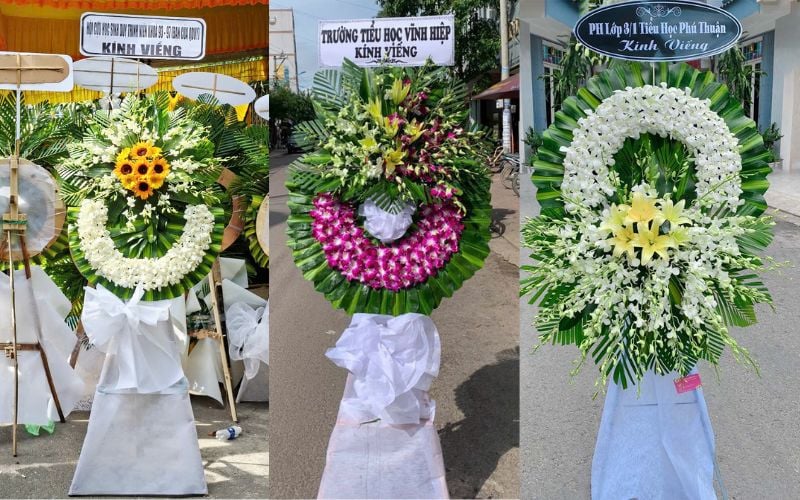
Ribbon wording for a wreath from a class or from close friends
Choosing suitable funeral flowers
The kind and colour of the flowers in a funeral wreath matter too. Customs differ from region to region, and families also take account of the age and religion of the person who has died. Choosing in keeping with the family’s own way of life and beliefs is a mark of respect and understanding. What follows are common preferences, not fixed rules.
By region
The north: yellow flowers are often preferred, yellow chrysanthemums, yellow roses, yellow orchids, yellow lilies. The traditional oval wreath in several colours, still sober in effect, is common. Standing arrangements with fresh flowers set in a circle, as in the south, are also used. In some places wreaths are still made mainly of bead flowers and red roses, arranged in an ellipse.
The centre: white tones tend to come first, white orchids, white chrysanthemums, white roses, white lilies.
The south: white and purple are the most common, white chrysanthemums, orchids, roses and lilies, or white combined with purple. Standing arrangements with a circular or a freer, modern design are popular.
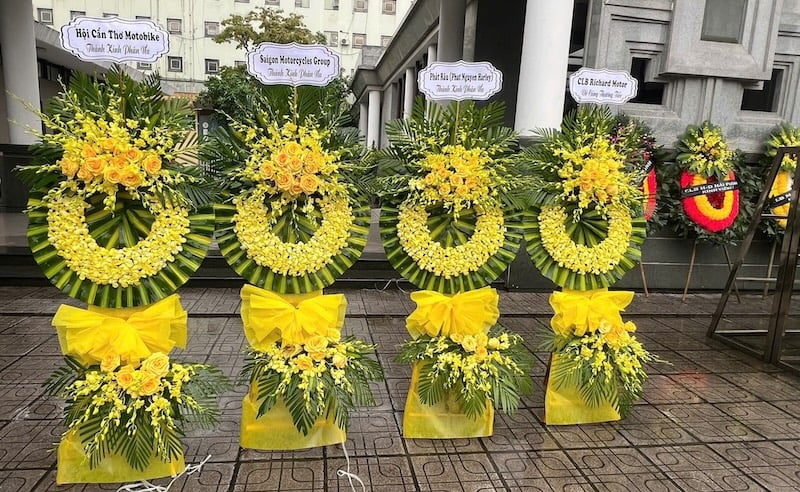
In the north, yellow is the colour most often chosen for a funeral wreath
By the age of the person who has died
A young person: mainly white flowers, white orchids, white roses, white chrysanthemums, white lilies. White is considered the most fitting choice here, standing for mourning and purity.
A middle-aged person: white or purple, or the two combined. For example white phalaenopsis orchids, purple phalaenopsis orchids, or white chrysanthemums with white roses.
An elderly person: yellow and purple are usual, purple or yellow orchids, yellow lilies, yellow chrysanthemums, yellow roses, purple roses, purple chrysanthemums. Chrysanthemums and lilies in white, purple or yellow, or a restrained mix of colours, all work.
A person of standing in society: more formal flowers such as orchids, especially phalaenopsis orchids.
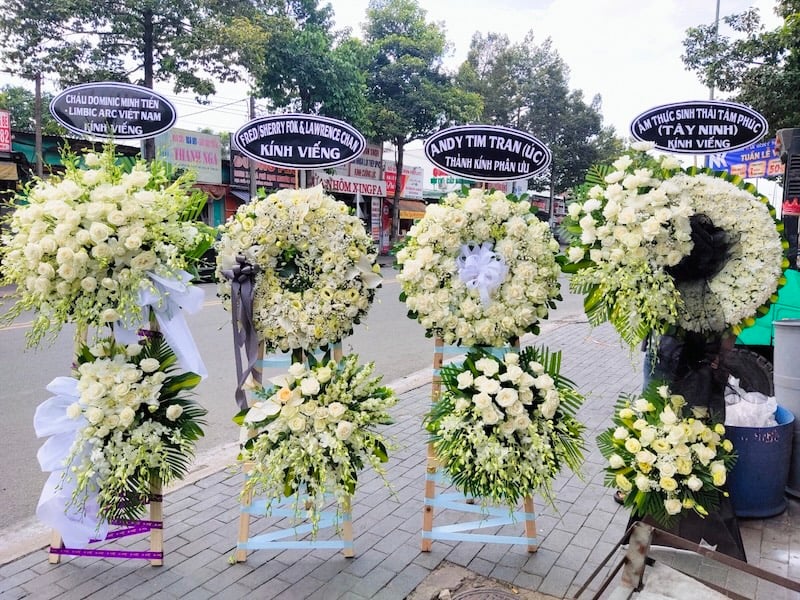
White flowers are the usual choice when the person who died was young
By the family’s religion
A Catholic funeral: white or purple flowers are usually preferred. White is taken to stand for purity and gratitude, purple for love and esteem. Arrangements in the shape of a cross are a good choice, and a white-and-black scheme set out as a cross is very common.
A Buddhist funeral, or a family with no particular religion: lotus (a symbol of purity), chrysanthemums, orchids and roses are often used, in a circular, oval or free arrangement, with yellow or purple as the main colour.
Colours of the ribbon and its lettering
The usual, formal colours for the lettering are white, black or purple, which look quiet and refined.
The lettering can contrast with the background of the ribbon so that it stands out and is easy to read.
The most common ribbon is black with white or yellow lettering.
Also often seen: a white ribbon with black or purple lettering, or a purple ribbon with white or yellow lettering.
When to send funeral flowers
Sending the wreath at the right moment matters as well:
The best time is while the funeral is being held at the family home or at the funeral home. A Vietnamese funeral usually lasts several days, with visitors coming to pay their respects throughout.
Send flowers only after the body has been placed in the coffin and before the coffin leaves for burial or cremation. These two rites are called khâm liệm and di quan.
Avoid sending too early (before the coffin has been closed) or too late (after it has left), so that the wreath keeps its meaning.
The morning is usually the most suitable time, especially before the main ceremonies of the day begin.
The afternoon is also fine, as long as it falls within the visiting period the family has announced.
Try to find out exactly when and where the funeral is taking place, so that the flowers arrive properly.
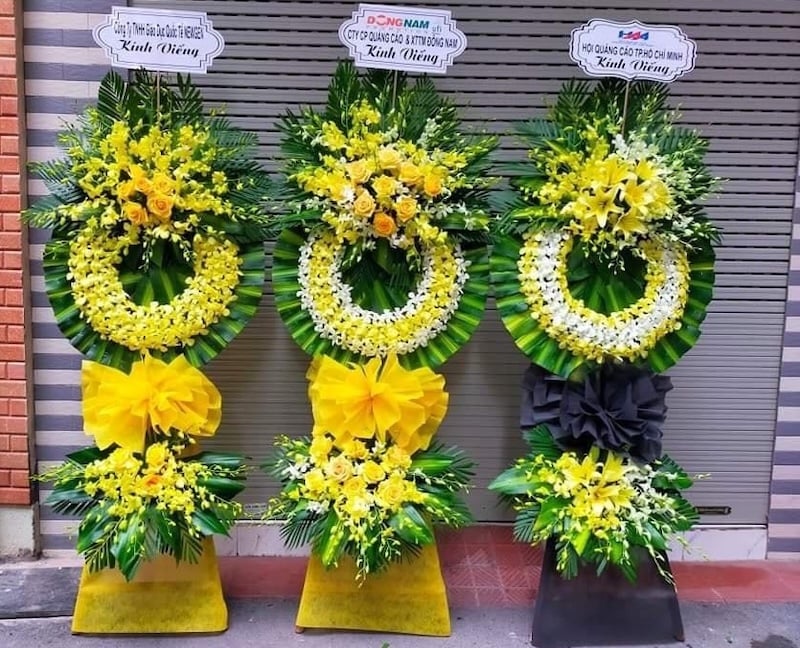
Send flowers after the body has been placed in the coffin and before the coffin leaves
We hope this guide from Flosa has made clear what a funeral wreath means, what to write on the ribbon so that it is fitting and formal, and how to choose flowers that say what you feel. Whatever words or flowers you settle on, your sincerity towards the person who has died and your sympathy for the family are what count most at such a time.
See Flosa’s sympathy flowers, quiet in style and full of meaning.
Showing respect and offering condolences in the proper way comforts the bereaved family, and it is also part of what Vietnamese people regard as good manners. Let a dignified funeral wreath and a sincere line on its ribbon carry your feelings for you.