


















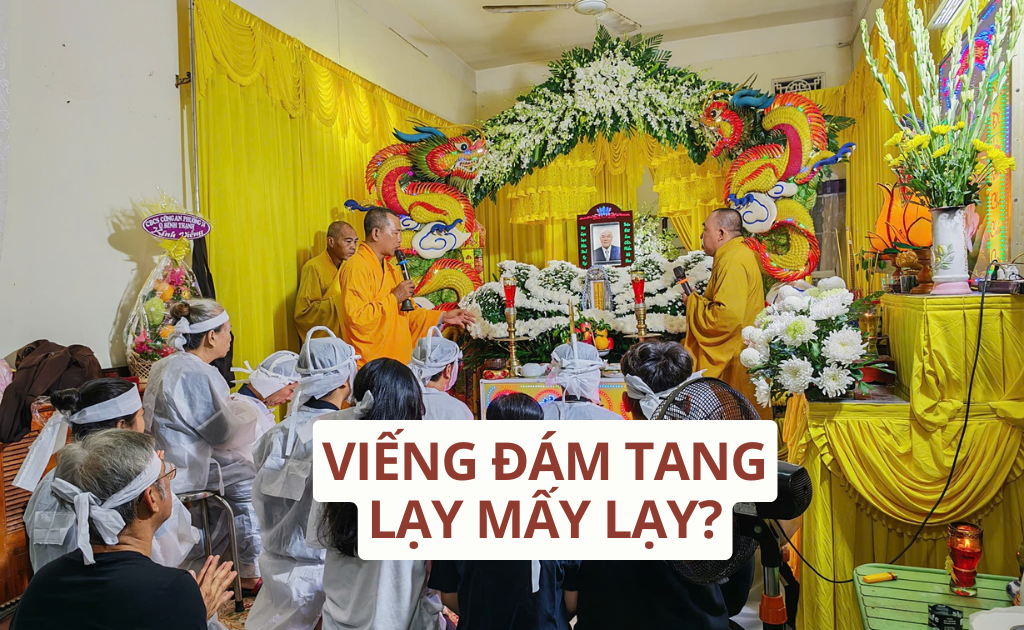
Bowing at a Vietnamese funeral: how many times, and how
Bowing when you pay your respects at a funeral is a long-standing part of Vietnamese culture. It expresses grief and reverence for the person who has died, and respect for the bereaved family. Not everyone is sure how to do it properly, though. In this article Flosa explains what the bows mean, how they are made, how many are customary, and what else a visitor should keep in mind.
What bowing means at a Vietnamese funeral
Bowing at a funeral is more than a formality. It carries several layers of human and spiritual meaning, and reflects values that sit at the heart of how Vietnamese people behave towards one another.
An expression of grief and deep respect
Lowering your head before the coffin or the portrait of the deceased is regarded as the most sincere and dignified way to show sorrow at a person’s passing. It is also how the living show reverence for someone who has gone for good. The gesture is a tradition, and a standard of good conduct, that has been handed down through many generations.
A sign of your relationship to the deceased, and of good manners
The way a person bows also reflects their relationship to the one who has died: children and grandchildren bowing to a grandparent, a friend to a friend, a junior colleague to a former superior. Following the ritual correctly is also seen as a mark of someone who understands etiquette and who respects both the family and the solemn mood of the occasion.
A prayer for the soul to find peace
In Vietnamese spiritual belief, joining your hands and bowing, or kneeling before the altar and the coffin, is a sacred act. It is a prayer, and a hope that these sincere gestures will help the soul of the deceased to be released soon and to pass gently into the next world, free of earthly ties.
Filial piety and remembrance
The custom is also closely tied to filial piety, the duty that children and grandchildren owe to their parents and grandparents, and it is felt as a way of staying in touch with elders who have passed on. It expresses boundless respect, gratitude for having been born and raised, and remembrance: a promise that the person and the good they stood for will stay in the minds of those left behind.
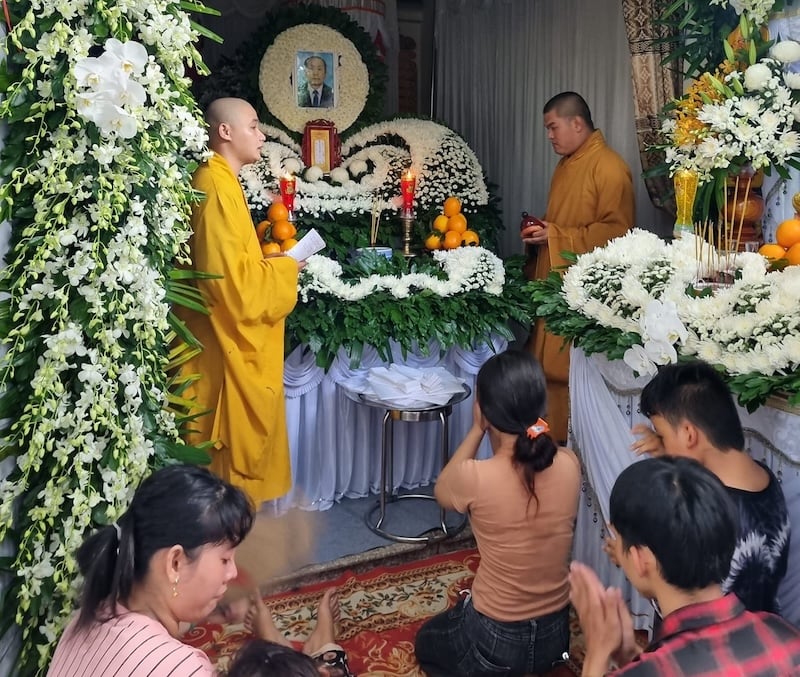
Bowing at a funeral expresses reverence and filial piety
How to bow at a funeral according to Vietnamese tradition
To perform the ritual properly, it helps to know that Vietnamese has two different words for it: lạy, a full, deep bow, and vái, a shorter bow made with joined hands. In this article we call them the full bow and the short bow.
The full bow: posture and movements
The full bow (lạy) shows the highest degree of respect. It is made slowly and with sincerity.
Standing bow: Stand straight and composed, palms pressed together in front of your chest. Slowly raise your joined hands to the level of your forehead (some people raise them slightly above the head), then lower them in front of your face until they are back at chest height. The movement should be gentle and unhurried. Keep facing forward, towards the altar or the coffin, and as your hands come down, lower your head respectfully with them.
Kneeling bow (to the ground): To show even deeper respect, as children and grandchildren do for their parents and grandparents, the bow can be made kneeling. After raising your hands to your forehead and lowering them to your chest, slowly go down on both knees and place your hands on the floor or the mat. Depending on local custom the palms may face up or down. Then lower your head until your forehead almost touches, or touches, the ground.
Holding incense: While bowing, a visitor may hold one lit incense stick (or three) between the joined palms. When the customary number of bows is complete, step forward and place the incense in the incense bowl on the altar.
In general: The whole movement should be gentle, slow and calm, and should convey solemnity and respect.
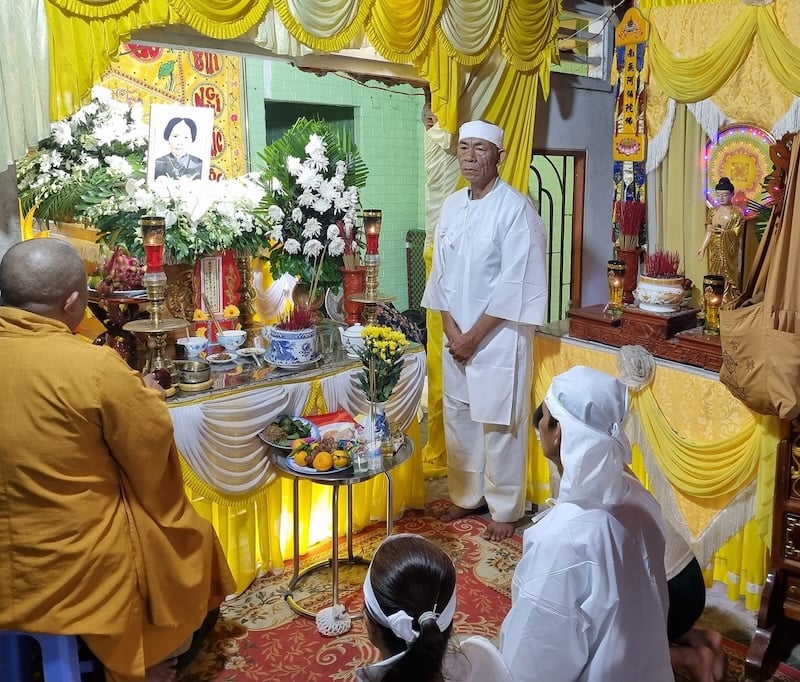
The standing bow and the kneeling bow at a funeral
Video: how to bow at a funeral
The video at the top of this article goes with this guide.
The short bow, and how it differs from the full bow
The short bow (vái) is also a gesture of respect, but a lighter one, and it differs from the full bow in a few ways:
Posture: You may stand or kneel, with your hands still joined in front of your chest.
Movement: The hands are brought down from the forehead or head to the chest more quickly than in a full bow.
Head: The head dips only slightly, not deeply as in a full bow.
Pace: It looks much like a full bow, but is done noticeably faster.
When: Short bows usually come after the full bows are finished, and there are usually two of them. The exception is after the burial: at the grave, three short bows may be made.
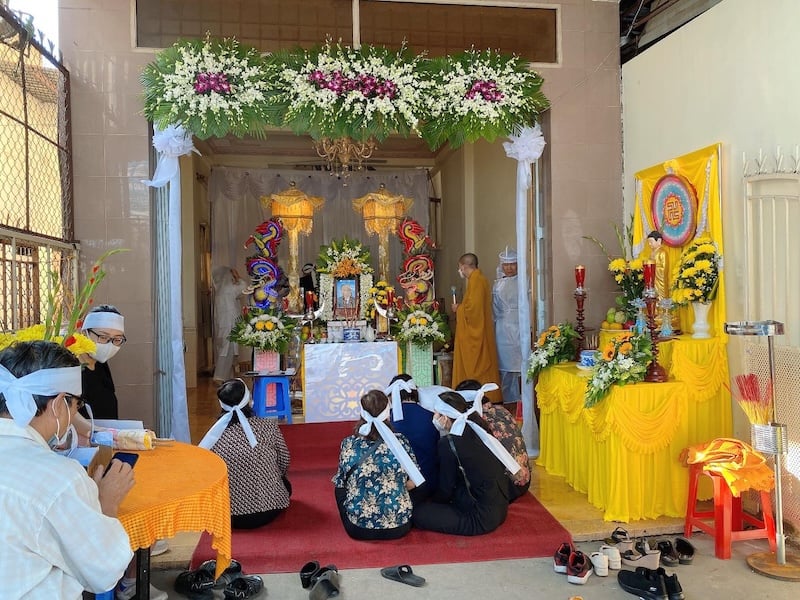
How to bow at a funeral
How many full bows and short bows are customary?
The number of bows at a funeral is an unwritten rule passed down through the generations, and it changes with who is being honoured and in what circumstances. So how many is right?
The general rule in traditional ceremonies
In Vietnamese culture the number of full bows carries a meaning of its own:
Two bows (nhị lạy): customarily for the living, for example children bowing to their parents at Tết or at a longevity celebration.
Three bows (tam lạy): for the Buddha, for saints and deities, or for Buddhist monks and nuns.
Four bows (tứ lạy): for the spirit of someone who has died, as the highest mark of respect for a person who has passed into the next world.
See also: sympathy flowers for a funeral
When the deceased is still lying in the coffin (before burial)
While the deceased is still lying in state at home or at a funeral home, that is, while the coffin is present and the burial or cremation has not yet taken place, visitors customarily make:
Two full bows, followed by two short bows.
Note: Some people hold that, before the burial, members of the family make only two short bows and no full bows. The more widespread practice at funerals, however, is that everyone who comes to pay respects, relatives and guests alike, makes two full bows and two short bows while the coffin is still there. If you are unsure, following this more common practice is the safe choice.
When there is a Buddhist altar: If the family has set up an altar to the Buddha in front of the table that holds the portrait of the deceased, visitors are expected to go in this order:
First, bow before the Buddhist altar: three full bows and two short bows.
Then step to the table with the portrait of the deceased and make two full bows. These are the same two bows given to the living: a last farewell while the person is, in a sense, still “there”.
So how many times do you bow at a funeral before the burial? The most common answer is two full bows.
When offering incense after the burial or cremation
If you come to offer incense at the grave after the burial, or at the place where the portrait is kept for long-term worship once the cremation and the funeral rites are over, the numbers are different:
Four full bows, followed by three short bows.
By this time the deceased is considered to have truly passed into the next world, so four bows are made, as the highest mark of respect for the spirit.
Whether two, three or four bows are right therefore depends on who is being honoured and on the circumstances, as explained above.
See also: what to write on a funeral wreath ribbon, and wording for a condolence flower basket
The family’s bow in return
When guests come and bow, a representative of the bereaved family (the tang chủ, or chief mourner, usually the eldest son, the eldest grandson in the male line, or another senior relative) stands beside the coffin and returns the gesture.
By custom the family representative returns exactly the same number of full and short bows that the visitor has just made. If a guest makes two full bows, the host answers with two.
This is understood as “returning the courtesy in full”: the family’s way of thanking and honouring those who have come to share their grief.
The return bow is made only while the coffin is still at the place of the ceremony, whether at home or at a funeral home. After the burial it is no longer done.
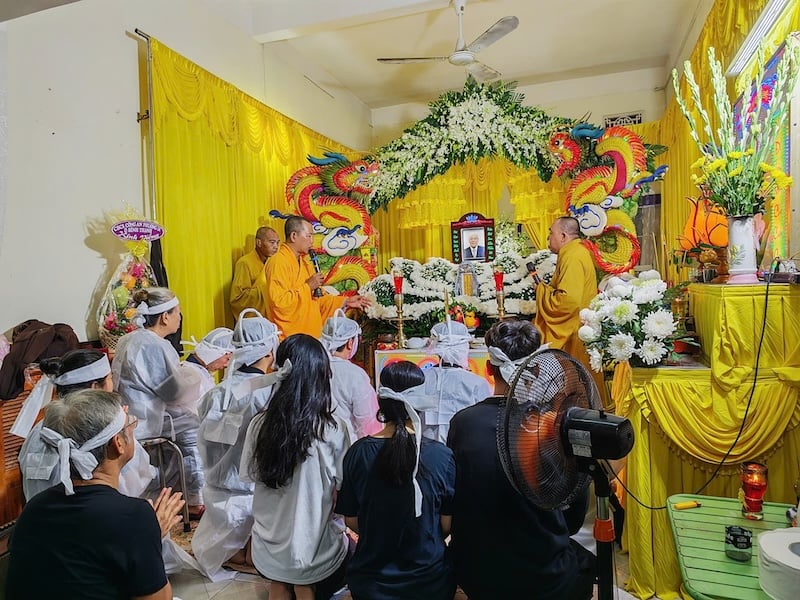
The customary number of full bows and short bows at a funeral in Vietnam
How men and women bow at a funeral
Tradition also makes a distinction between the way men and women bow: a woman’s bow is meant to be soft and modest, a man’s firm and solemn.
How men bow
Prepare: Stand straight and composed, hands joined in front of the chest.
Bow: Slowly raise the joined hands slightly above the head, then bend forward.
Go down: As you bend, open your hands and place them palms down on the floor. At the same time go down on both knees and lower your body until your forehead nearly touches, or lightly touches, the floor or the mat. This posture expresses the deepest grief and respect.
Rise: After holding the bow for a few seconds, bring your hands together on your left knee. Draw the left leg up, rise slowly, and return to the upright position you started from.
How women bow
A woman’s bow is customarily gentler and more reserved:
Prepare: Slowly sit down on the floor with the legs folded to one side, leaning towards the left. The right foot is turned sole up and tucked under the left thigh. This is the traditional sitting posture of Vietnamese women when bowing.
Bow: Join your hands in front of your face, slowly raise them to your forehead, then gradually lower your head.
Go down: As your head nears the floor, slowly open your hands and rest them lightly on top of your head (in some places they are laid palms down on the floor in front of you instead). Hold the position for one or two seconds. Repeat for the customary number of bows.
Rise: When you have finished, stand up slowly and take a few quiet, composed steps backwards.
Note: Descriptions of the woman’s bow vary a little from family to family and from region to region, and you may be given specific guidance at the funeral itself. What matters is a respectful, solemn manner.
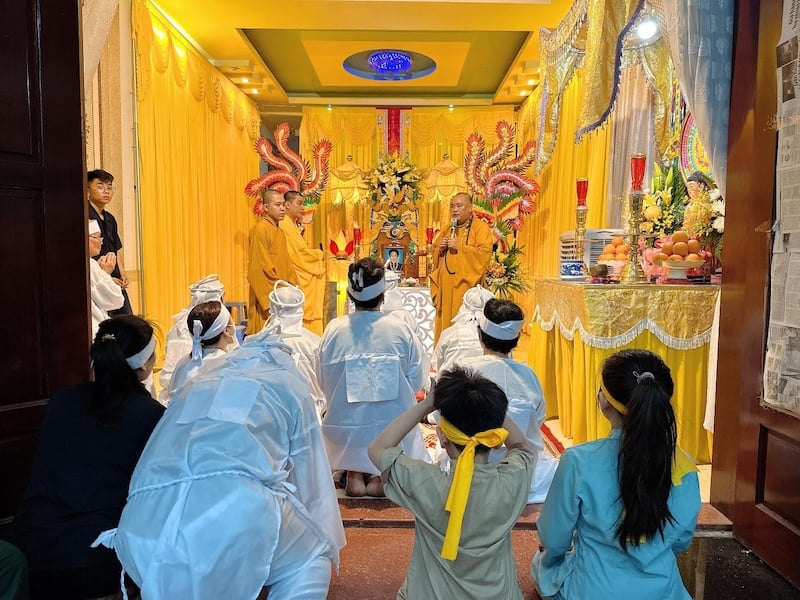
The traditional difference between how men and women bow at a funeral
Rules and taboos to keep in mind when paying your respects
To show respect and avoid giving offence, visitors are expected to observe a few rules and taboos.
Visit only after the body has been placed in the coffin
By custom, people outside the immediate family come to pay their respects only after the nhập liệm rite, the placing of the body in the coffin, has been completed.
What to wear: a sign of respect
Clothing matters a great deal. It shows your respect for the deceased and for the family. For more detail, see our guide on what to wear to a Vietnamese funeral.
Dress neatly, tidily and soberly.
Choose subdued colours such as black, white, grey or navy. Avoid bright, showy colours altogether.
Men: a dark shirt (a smart polo shirt is acceptable) with dark trousers or dark jeans. Avoid shorts, vests, collarless T-shirts and flip-flops.
Women: avoid very short or revealing dresses (bare shoulders, back or chest), ripped jeans and shorts. Clothes should be modest and fall below the knee. A dark áo dài (the traditional long tunic), a shirt with trousers, or a plain long skirt are all suitable. Keep sparkling jewellery to a minimum, and avoid flip-flops or very high heels that make a noise as you walk.
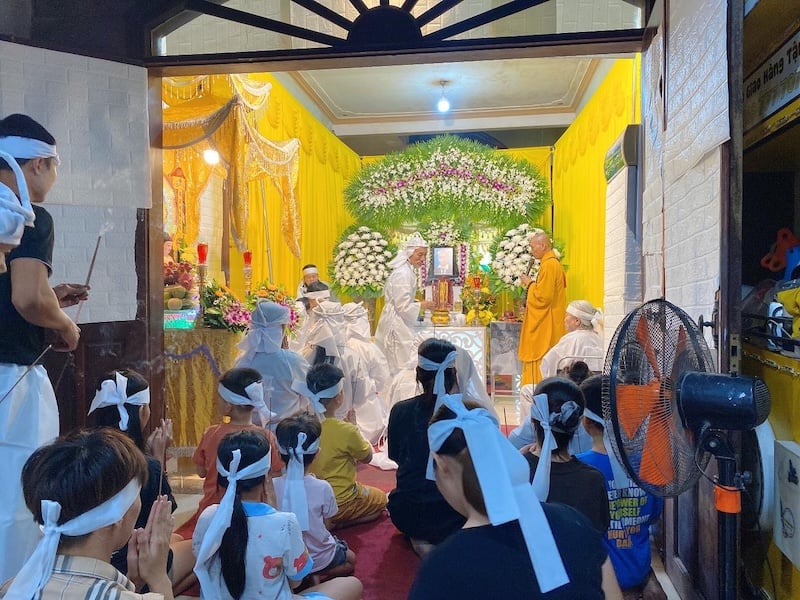
Dress neatly, tidily and soberly when you pay your respects
Other taboos
Stay quiet and composed: Do not laugh and joke, talk loudly, take loud phone calls or behave in any way that is out of keeping with the solemn mood of a funeral.
Do not let tears fall on the body during the shrouding: According to an old belief, if the tears of the living fall on the body, the soul may find it hard to depart, or may linger in this world. This applies mainly to family members who take part in the khâm liệm rite, the shrouding of the body.
Silence your phone: Turn the ringer off or switch to silent mode, so that no unwelcome sound breaks the solemnity of the ceremony.
What to bring
What you bring depends very much on your relationship with the deceased, on when you visit, and on the customs of the region and the family.
A condolence envelope of money (phúng điếu): the most common offering, a practical way of sharing the family’s funeral costs.
Items for worship: incense, candles, and votive paper offerings (vàng mã), depending on the family’s beliefs.
A basket of fresh fruit.
A funeral wreath: a formal and meaningful choice.
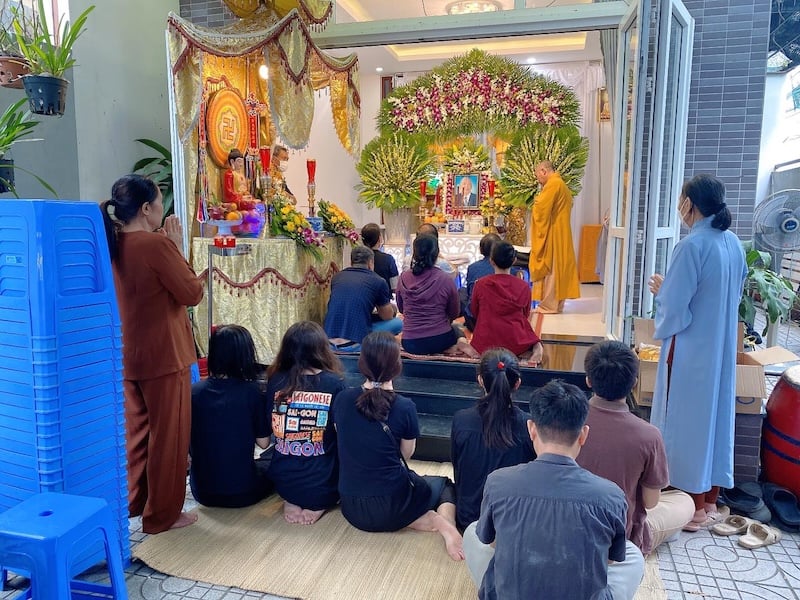
Dress rules and taboos when paying respects at a funeral
Bowing is an essential part of a traditional Vietnamese funeral, and a deep expression of respect, grief and sincere feeling for the person who has died. Understanding the customs, from posture and movement to the number of bows, helps you to express that feeling fully and to honour a tradition the Vietnamese hold dear.
Funeral wreaths and flower stands from Flosa:
See the funeral wreath collection
Order at: Flosa.vn
We hope this guide has answered your questions about how many times to bow at a Vietnamese funeral and how to do it. What matters most is your sincerity, and your wish to share the family’s grief at a painful time.