




















Funeral customs are among the oldest parts of Vietnamese culture. Yet not everyone knows the rites in detail, or what they mean. Here Flosa sets out the main customs of a Vietnamese funeral for reference.
You may also be interested in:
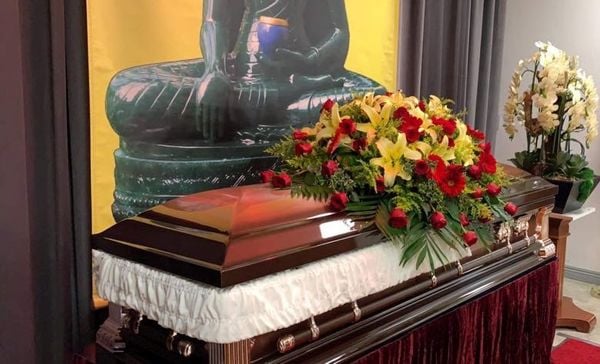
Traditional Vietnamese funeral customs, handed down through the generations
What funeral customs mean to the Vietnamese
Funeral rites are seen as the respect and reverence that the living owe to someone who has just died. In Vietnamese tradition the human soul is held to be sacred, so giving the dead a proper funeral is a moral standard that has long been deeply rooted in people’s minds.
A funeral is also the way family, relatives, friends and neighbours show their sincere feeling for the person who has died. Visitors customarily bring a condolence offering, called phúng điếu, as a sign of deep sympathy. The money given also helps the family with the cost of the funeral at a time when they are distressed.
On the spiritual side, death is understood as the soul leaving the body: the flesh decays, but the soul is believed to live on. That is why a funeral is held, with ceremonies and offerings, so that the soul may soon find release.
The main terms and rites of a Vietnamese funeral
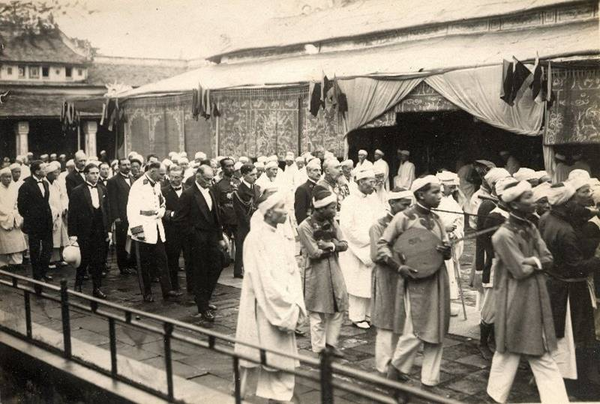
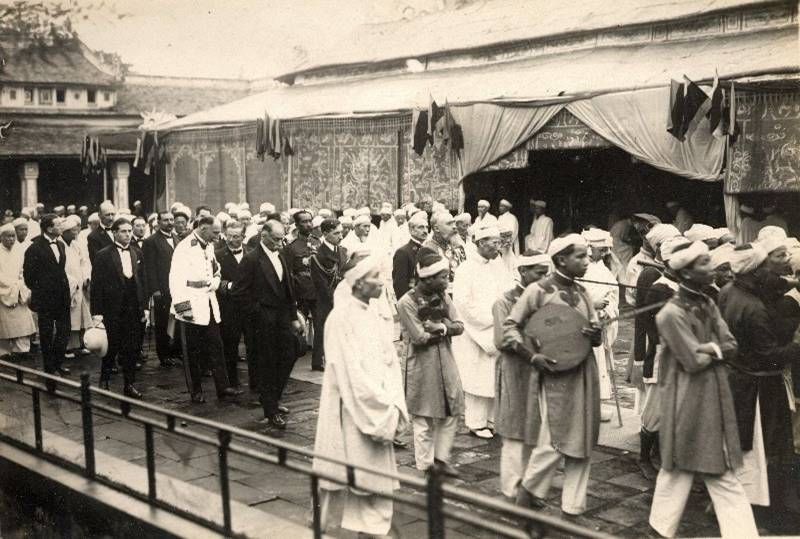
A traditional Vietnamese funeral in former times
Rites of preparation before the burial
- Trùng tang (literally “repeated mourning”): In some regions of Vietnam, the family is expected to note the exact day and hour when the person drew their last breath, to see whether it falls at an inauspicious time. If it does, the family pastes a paper charm on the lid of the coffin after the body has been shrouded. On the way to the burial, a person dressed as a warrior-general walks ahead of the procession performing a sword dance to drive off evil spirits. At the burial, four snail shells are placed at the four corners of the grave.
- Setting up the mourning altar (lập bàn thờ tang): A “bed for the soul” is placed on the east side, with a pillow and a curtain as when the person was alive. The altar stands in front of the coffin. In the middle of it are a memorial tablet bearing the person’s full name and the portrait of the deceased. The incense bowl goes in front, with lamps or candles, rice wine and a tray of five kinds of fruit on either side.
- Hạ tịch (laying the body on the ground): This rite carries the idea that people come from the earth and return to the earth when they die. A mat is spread on the ground and the body is laid on it for a short while before being lifted up again, in the hope that the earth will give the breath of life back to the person who has just died.
- The death notice (cáo phó): A notice posted in front of the house in mourning. It gives the details of the person who has died (name, date of birth, day and hour of death) and the time and place of the ceremony and of the burial, to inform relatives and friends. Today people also post the notice on social media, and change their profile picture to black or to a white lotus as a way of saying that the family is in mourning. Those who cannot come in person can still send the family their condolences.
- Shrouding and placing in the coffin (khâm liệm and nhập quan): In the shrouding rite the body is wrapped in white cloth. For the placing in the coffin, the relatives stand around, lift the body on a length of cloth and lower it into the coffin. A bowl of rice with a boiled egg and a pair of chopsticks stuck upright in it is set on top of the coffin. By custom the coffin is always placed with the head pointing outwards, towards the door.
- Handing out the mourning clothes (phát tang): Also called the thành phục rite. Each member of the family and the wider kin is given mourning dress, puts on the mourning tunic and ties on the mourning headband (which differ according to their place in the family), and is formally in mourning from that moment.
- Condolence offerings (phúng điếu): This is a distinctive custom of Vietnamese funerals. People who come to pay their respects bring an offering as a way of asking after the family, sharing their loss and giving them heart. It may be money, fruit, or incense and candles. In some families, those who are wearing mourning dress do not come out to receive the visitors. Depending on the family’s custom, visitors either bow in the traditional way or simply lower their heads before the coffin. Nowadays some families ask not to be given money. In that case you can bring a fruit basket or a funeral wreath instead to show your sincerity.
Rites of the burial
- Moving the coffin (động quan): The coffin is carried to its final resting place, for burial or for cremation. This is usually done by the funeral service team or by strong young men of the village.
- Lowering into the grave (hạ huyệt) or cremation: The burial or the cremation is carried out, according to what the family has chosen.
- Bringing the portrait home (rước di ảnh): The portrait of the deceased is carried home and placed on the altar, where the family goes on burning incense and making offerings.
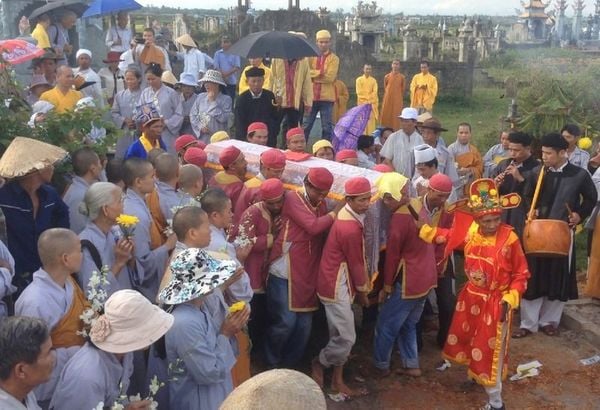
Taking the coffin of the deceased to its final resting place
Rites after the funeral
- The third-day ceremony: Three days after the burial, the family makes offerings and visits the grave. This is also called mở cửa mả, “opening the door of the grave”.
- The 49th-day ceremony: Also called chung thất, the end of the seventh week. After the burial, once the altar has been set up, the family offers a meal to the deceased every day. In the seventh week they hold the chung thất ceremony and stop the daily offering of meals.
- The 100th-day ceremony: After 100 days the family invites a ritual master to perform the thôi khóc rite, “the end of weeping”. He burns mourning clothes and belongings of the deceased, and the portrait is then moved up to the ancestral altar.
- The first death anniversary (giỗ đầu): One year after the death, counted by the lunar calendar, the family holds the first anniversary in remembrance.
- The end of mourning (xả tang): Also called mãn tang. Three years after the death, the family holds a ceremony that formally ends the mourning period.
How long does mourning last?
- Full mourning (đại tang): Full mourning lasts three years in name, but in practice people observe it for 27 months. It is worn for one’s own parents, by a daughter-in-law for her husband’s parents, by a wife for her husband, by the eldest grandson in the male line (or the grandson who stands in as chief mourner) for his grandparents, and by the great-grandson in that same position for his great-grandparents.
- Lesser mourning (tiểu tang): Mourning that lasts from three months to one year. The length depends on how close the relationship is.
See also:
- The cleansing custom after a funeral, and 11 taboos for visitors
- Sympathy flowers for a funeral
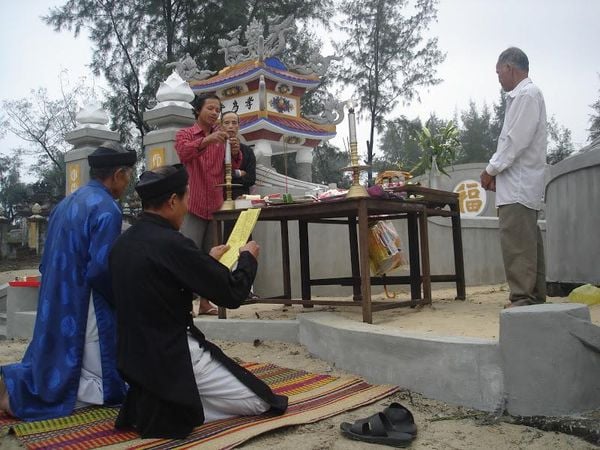
The Vietnamese rite that ends the period of mourning
Taboos in Vietnamese funeral custom
Tears should not be allowed to fall on the body. According to an old belief this could cause the corpse to be possessed by a spirit, and bring hard times to the descendants. So however great the grief, mourners take care to avoid it.
Before the body has been placed in the coffin, the family keeps watch so that no dog or cat comes near. The old belief is that otherwise the corpse might sit up.
By long-standing custom, willow wood is never used to make a coffin. The willow is said to bear no seeds, and it was believed that such a coffin would leave the family without descendants. Pine or cypress is used instead.
We hope this account of funeral customs has given you a clearer picture of traditions the Vietnamese have kept since early times, and of the taboos that families take care to observe.
See also:
- What to write on a funeral wreath ribbon, and suitable wording for a condolence flower basket
See funeral wreaths and flower stands from Flosa: