










In a traditional Vietnamese engagement, the groom’s family brings a set of gift trays to the bride’s home. The trays, called mâm quả in the South and tráp in the North, express respect and a solemn promise. By long custom the gifts are carried on red lacquered, gilded trays and stand for the wish that the couple will live in harmony for a hundred years. The number of trays and what they hold vary with the region, the family’s means and local habit, and that variety is part of Vietnamese wedding culture. This article explains what the trays contain and how to prepare them and the wedding flowers according to custom, with particular attention to the South and the Mekong Delta.
What the engagement gift trays are and what they mean
The engagement ceremony is called đám hỏi or lễ ăn hỏi, and the gift trays are its central rite. The ceremony makes the couple’s relationship official: from that day they are formally engaged, witnessed and blessed by both families.
By preparing the trays, the groom’s family shows care, respect and deep gratitude to the bride’s family for bringing her into the world and raising her. Each gift has its own symbolic meaning, and together they stand for good wishes of love, happiness, plenty and harmony in the marriage to come.
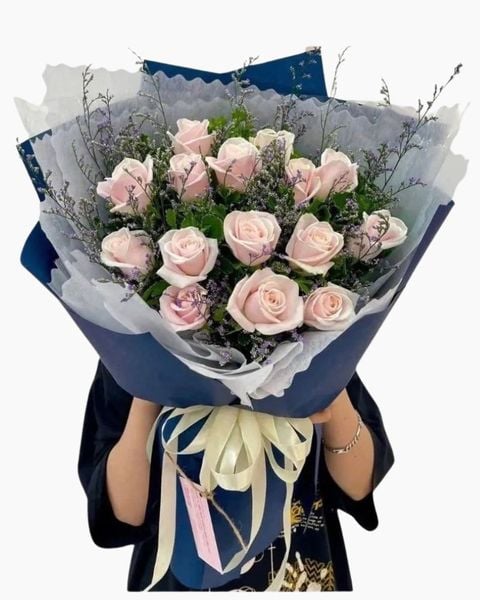
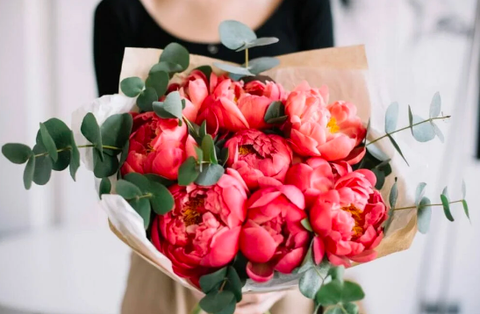
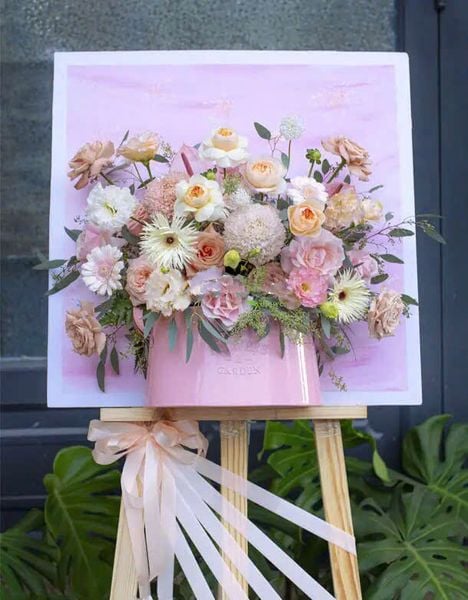
See also: wedding flowers, bridal bouquets and buttonholes.
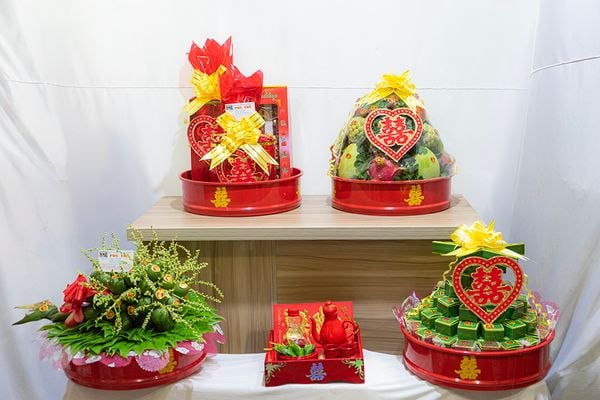
The meaning of the engagement gift trays
The engagement trays in southern custom
In the South the custom has a character of its own, generous and attentive to ceremony. The number of trays is usually even, most often six or eight, because southerners hold that even numbers stand for abundant fortune and complete happiness.
A southern set is usually put together from the following trays.
The betel and areca tray
The first and most important tray, missing from almost no wedding, is trầu cau: betel leaves and areca nuts. A Vietnamese saying goes miếng trầu là đầu câu chuyện (“a quid of betel begins the conversation”). Betel and areca mark the beginning of the union between the two families and show the respect of the younger generation for those who came before. In a southern engagement the tray carries the wish for a hundred years of happiness, traditionally with an odd count of 105 areca nuts accompanied by 210 betel leaves.
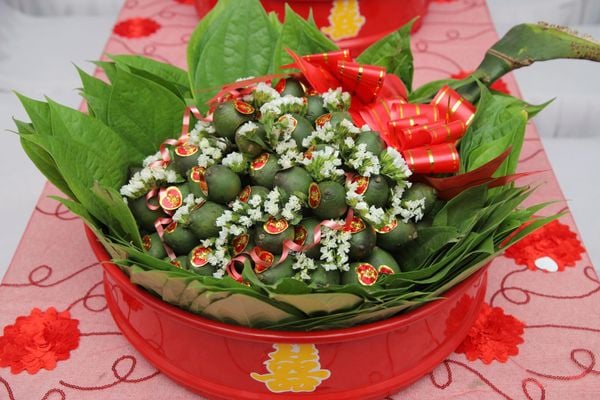
In southern tradition the betel tray holds 105 areca nuts and 210 betel leaves
The fruit tray
Next comes the fruit tray, which people of the Mekong Delta consider indispensable. It carries wishes for good things and plenty, read from the names of the fruits themselves.
By southern and Mekong Delta custom, the five-fruit tray for an engagement usually holds custard apple, mango, dragon fruit, grapes and apples. Today the fruit is often combined with fresh flowers, which adds a focal point and a more formal look.
See also: fresh flower and fruit arrangements.
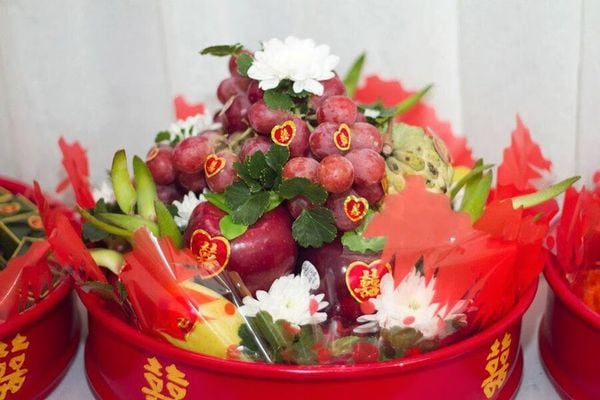
The five-fruit tray changes with the season and the region
The husband-and-wife cake or cream cake tray
The next tray holds bánh phu thê (“husband-and-wife cakes”, small sticky cakes given in pairs) or a cream cake, standing for sweetness and happiness in marriage.
This tray differs by region. The Centre and the North usually use husband-and-wife cakes or bánh cốm (green young-rice cakes), while the South and the Mekong Delta prefer a cream cake. The cream cake is usually round, which is taken to represent the sky and the harmony of yin and yang between husband and wife, bringing the couple a happy and comfortable life.
The tea and wine tray
A folk saying has it: khách đến nhà, không trà thì rượu (“when a guest comes to the house, offer tea, or else wine”). The two are present at almost every gathering of friends and family, so the list of trays keeps a place for tea and rice wine, which are offered on the family altar. The tray expresses devotion to grandparents and ancestors, asking those who came before to witness the engagement and protect the young couple.
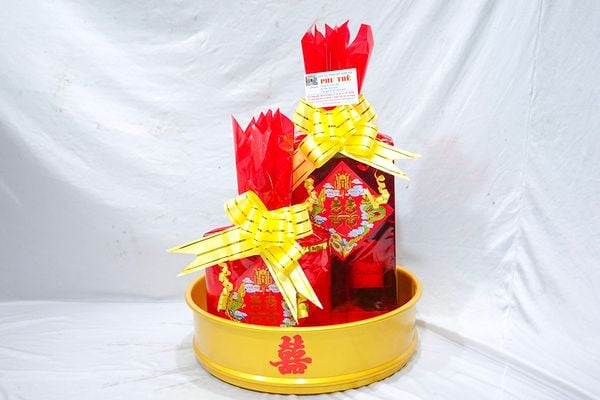
The traditional tea and wine tray shows respect for the elders
The sticky rice and chicken, or roast pig, tray
Next on the list is a tray of sticky rice with chicken, or a roast pig. A family chooses one of the two according to preference and need. Each has its own meaning:
Red sticky rice and chicken: xôi gấc is sticky rice coloured orange-red with gac fruit. The colour is regarded as lucky and as a sign of the couple’s steadfast love. The chicken stands for wealth and plenty, echoing the saying gà đẻ trứng vàng (“the hen that lays golden eggs”).
Roast pig: being costly, a roast pig is a wish for plenty and prosperity. Many people also believe that giving a roast pig helps the newlyweds have a child soon.
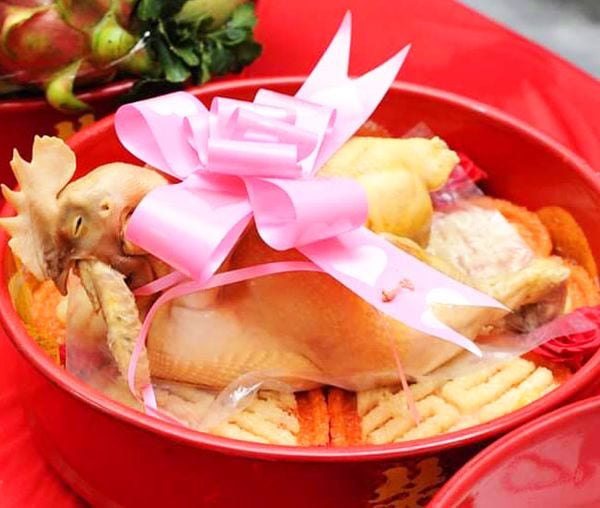
The sticky rice and chicken tray is a traditional choice for many families
The ao dai tray
In many places it is the tradition for the groom’s family to prepare a wedding ao dai, the Vietnamese long tunic, for the bride. She wears it to greet both families, which signifies that in her husband’s home she will be cared for and will live a full and happy life beside the person she loves.
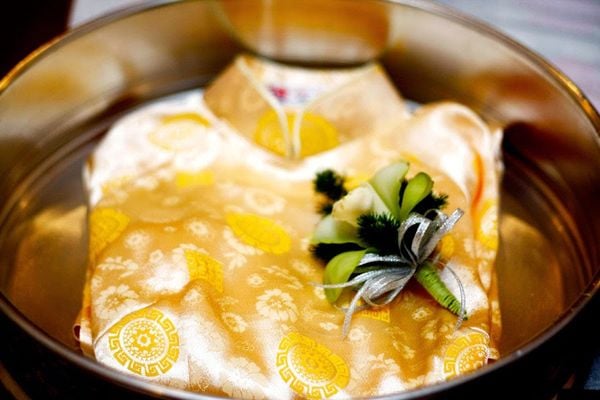
The ao dai tray is prepared by the groom’s family
The bride-price money tray
This tray, tiền nạp tài, holds the sum the bride’s family has asked for and the groom’s family has agreed to before the bride is taken home. The groom’s family usually chooses new banknotes, arranged neatly and formally in a bright red envelope. The money also helps the couple cover part of the cost of their wedding.
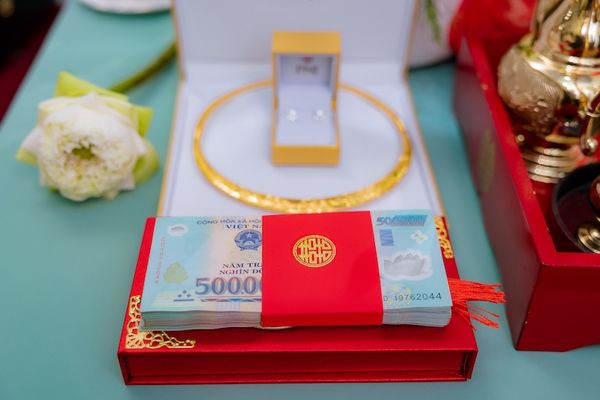
The bride-price tray holds the sum requested by the bride’s family
Beyond these basic trays, some better-off families in the South add a tray of clothes or jewellery for the bride, for example a pair of earrings that the groom’s mother puts on her daughter-in-law with her own hands. It shows the care and esteem of the groom’s family for their future daughter-in-law.
How many trays are usual in Vietnam
Knowing the meaning is one thing; knowing how many trays are enough is another. Below is what Flosa has gathered on the usual numbers in each region.
Northern engagement trays: odd numbers
The northern rule of thumb is trong chẵn ngoài lẻ (literally “even inside, odd outside”). In the North the usual number is from 3 to 11 trays, always an odd number. The contents can change with the family’s own tradition. The gifts are set out on red lacquered, gilded trays and covered with a red cloth decorated with a phoenix.
3 trays: betel and areca, tea, and candied lotus seeds.
5 trays: betel and areca, tea, candied lotus seeds, wine and cigarettes, and green young-rice cakes.
7 trays: betel and areca, tea, candied lotus seeds, wine and cigarettes, mung bean cakes, husband-and-wife cakes, and fruit.
9 trays: betel and areca, tea, candied lotus seeds, wine and cigarettes, mung bean cakes, husband-and-wife cakes, a flower basket arranged in the shape of a dragon and phoenix, and a roast suckling pig.
11 trays: everything in the set of nine plus other gifts, such as a tower of beer cans or soft sticky-rice cakes.
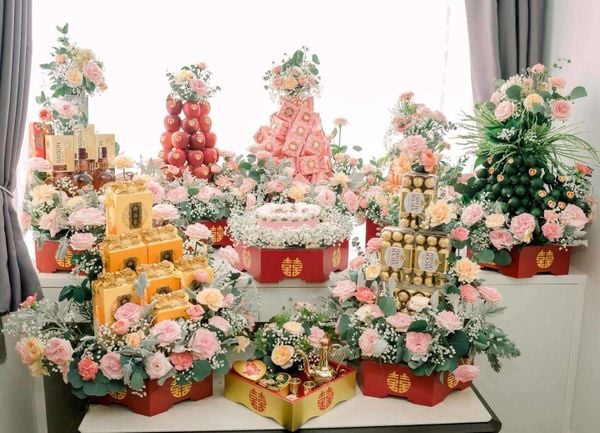
Engagement trays in the North
Central engagement trays: simple, with the wedding candles at the centre
In central Vietnam families tend not to dwell on the number of trays. What matters are four gifts that must be present: betel and areca, wine, husband-and-wife cakes and a pair of nến tơ hồng, red wedding candles decorated with a dragon and a phoenix.
Beyond those four, families who wish to give more can extend the set according to their needs and the scale of the wedding.
5 trays: betel and areca, wine, husband-and-wife cakes, a pair of wedding candles, and red sticky rice with boiled chicken.
6 trays: the five above plus Vietnamese pork rolls.
7 trays: the six above plus a roast suckling pig or fruit.
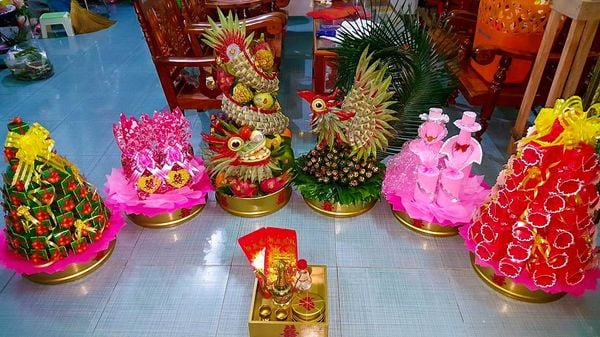
Engagement trays in the Centre
Southern engagement trays
Unlike the odd numbers of the North, the South favours even numbers: 6, 8 or 10. Many families choose 6 or 8 because in Sino-Vietnamese the words sound like Lộc (fortune) and Phát (prosperity), and are thought to bring luck.
6 trays: betel and areca; tea, wine and wedding candles; fruit; husband-and-wife cakes; red sticky rice and boiled chicken.
8 trays: betel and areca; tea and wedding candles; fruit; husband-and-wife cakes; a cream cake; red sticky rice and boiled chicken; the ao dai; the bride-price money and jewellery.
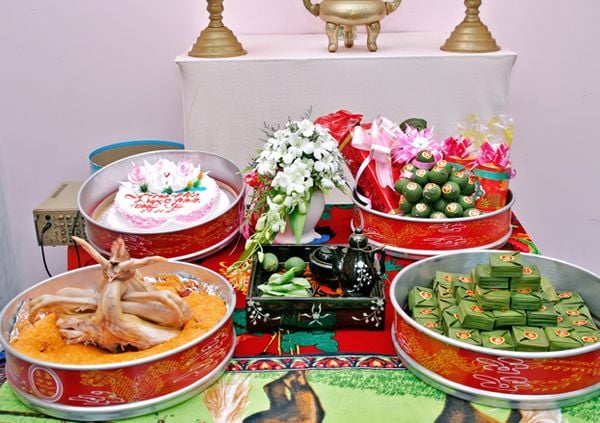
Engagement trays in the South
Mekong Delta engagement trays
In the Mekong Delta there are usually about six trays, and the gifts change with the family’s taste and circumstances. The main ones are betel and areca; tea, wine and candles; husband-and-wife cakes; seasonal fruit; and a roast pig.
Families here sometimes vary the set a little for something newer: a cream cake in place of the sticky rice, imported tea and spirits, or imported fruit.
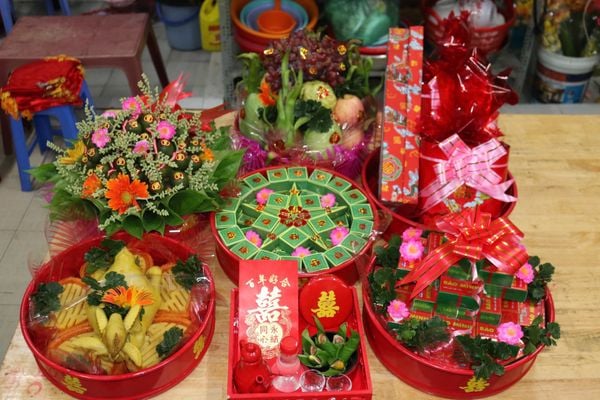
Engagement trays in the Mekong Delta
What the trays cost and what affects the cost
The cost of an engagement ceremony and its trays depends on each family’s means and on regional custom.
As a rough guide, a set of trays usually costs between 3,000,000 and 10,000,000 VND, depending on the number and kind of trays the family chooses.
5 trays: about 5,000,000 to 6,500,000 VND.
7 trays: usually 6,500,000 to 8,000,000 VND.
9 trays: about 8,000,000 to 10,000,000 VND.
There is also a sum of money given with the gifts, known as lễ đen. No rule fixes the amount; the two families agree on it, and it usually falls between 5,000,000 and 20,000,000 VND. It is regarded as a word of thanks and a meaningful gift from the groom’s family to the bride’s.
The main things that affect the total are the number of trays, the kind of gifts (whether there is a roast pig or jewellery), how elaborately the trays are decorated and the supplier the family chooses.
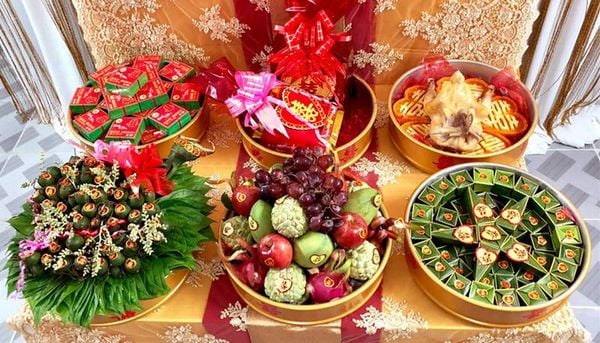
A southern set of six engagement trays
Important points when preparing and presenting the trays
For the ceremony to go smoothly, both families should keep the following in mind.
First, the two families should discuss the gifts carefully in advance, so that the ceremony matches what both sides expect.
For carrying and receiving the trays, there is a team of bearers, usually unmarried young men from the groom’s side, and a team of receivers, usually unmarried young women from the bride’s side. The number of bearers must match the number of receivers.
As for dress, both families and both teams should be neatly and formally dressed, in a traditional ao dai, a suit, or a shirt and smart trousers, out of respect for the ceremony. The bride usually wears a traditional ao dai.
The order in which the trays are carried should also be observed. The betel and areca tray always goes first, followed by the wine, the fruit, the sticky rice with the suckling pig or boiled chicken, and finally the cakes and tea.
When presenting and receiving the trays, the groom’s party lines up from the eldest to the youngest (grandparents, parents, the groom, then the bearers) to greet the bride’s family and hand over the gifts. Afterwards the bride and groom give red envelopes of lucky money to the bearers and receivers, to thank them and, as the saying goes, to lại duyên: to pass on good fortune in love.
Last comes lễ lại quả, the return of gifts. By custom the bride’s family keeps a portion of the gifts from each tray and hands the rest back to the groom’s family before they take their leave.
One very important point: always pay attention to the local customs and the religion of the bride’s family, so that the preparation is complete and both families are satisfied. The trays are usually prepared in the style and custom of the bride’s home region.
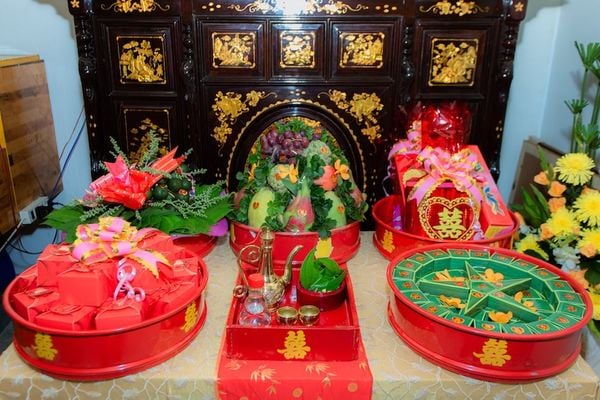
Points to remember when preparing traditional engagement trays
Flosa: decoration of engagement trays and wedding flowers
The engagement trays are more than gifts. They are a symbol of love and respect and a blessing on the start of a marriage. Preparing them with care shows the sincerity of the groom’s family and helps make a memorable day that marks the bond between the two families.
Flosa decorates ancestral-altar ceremonies and engagement trays, and also supplies wedding bouquets of baby’s breath and table flowers for weddings in a range of designs, made with flowers that arrive fresh each day.
Contact Flosa for advice on wedding services and wedding flowers:
- Phone: +84 90 252 6176
- Website: https://flosa.vn/
- Address: 689/27 Nguyễn Kiệm, Hạnh Thông, Ho Chi Minh City
We hope this article has made the meaning of the engagement trays and the customs of each region clearer. If you would like to know more about wedding flower decoration and the ancestral ceremony, call Flosa for advice.